We all grow up hearing that love should make us happy. We imagine having someone who understands us, supports us, and makes us feel safe. But sometimes, a relationship that once felt beautiful slowly starts feeling heavy.
You may find yourself overthinking every conversation, worrying about your partner’s mood, or wondering what you did wrong this time.
And the hardest part? From the outside, everything may look perfectly normal.
There may still be laughter, good days, apologies, flowers, gifts, and moments when you remember exactly why you fell in love with that person. That is what makes a toxic relationship so confusing. You don’t simply stop loving someone because they are hurting you.
You may even start telling yourself, “Maybe I’m being too sensitive,” or “Maybe if I change a little, things will get better.”
But love should never cost you your sense of self.
What Does a Toxic Relationship Really Look Like?
A toxic relationship isn’t necessarily one where two people argue all the time. Every couple has disagreements. The real question is what happens when those disagreements come up.
Can you talk about your feelings without being mocked or ignored?
Can you say no without being made to feel guilty?
Can you have your own friends, opinions, interests, and boundaries?
In a healthy relationship, you should be able to be yourself without constantly worrying about how the other person will react.
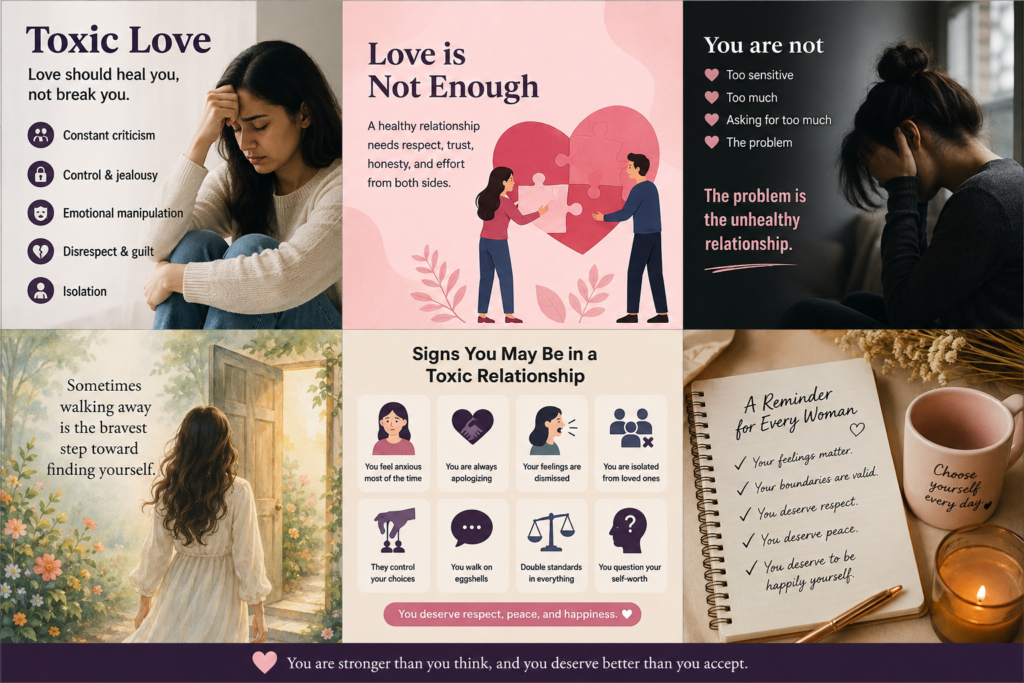
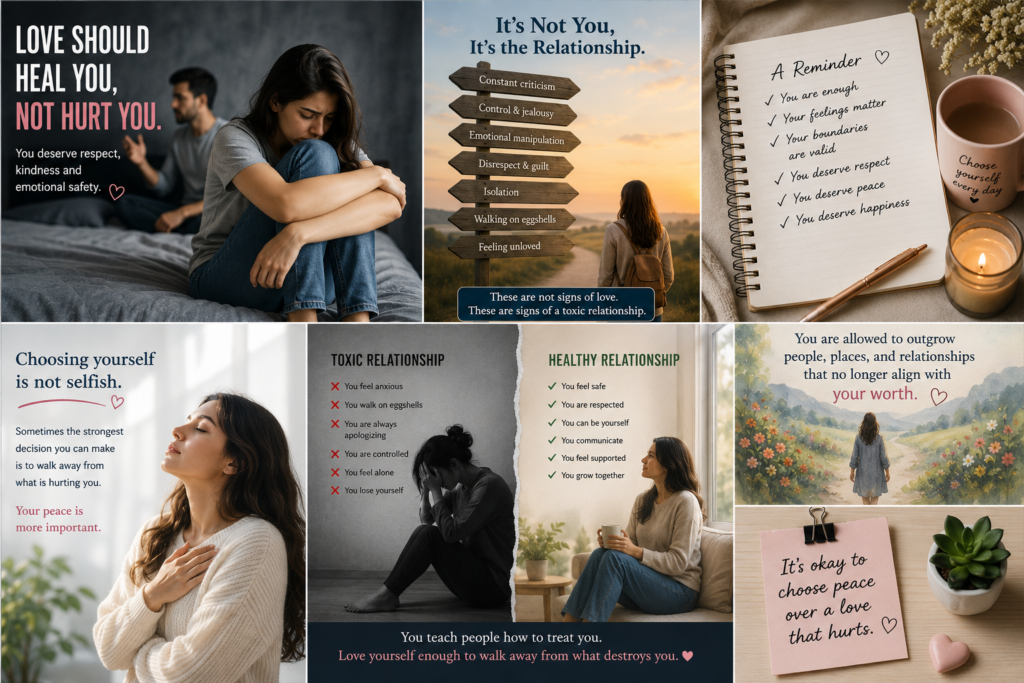
A toxic relationship often feels different. There may be constant criticism, jealousy, manipulation, controlling behavior, emotional neglect, humiliation, or guilt.
Sometimes it is not one huge incident. It is the same unhealthy behavior happening again and again until you slowly start believing that maybe you are the problem.
Signs You May Be in a Toxic Relationship
Sometimes the signs are easier to recognize when you stop looking at individual incidents and look at the pattern.
You might notice that:
- You are constantly worried about your partner’s mood.
- You apologize just to end an argument, even when you don’t believe you did anything wrong.
- Your feelings are regularly dismissed or called “dramatic.”
- You feel guilty for spending time with your family or friends.
- Your partner tries to control what you wear, where you go, who you talk to, or how you spend money.
- You think carefully before speaking because you are afraid of starting another argument.
- Your mistakes are brought up repeatedly, while your partner’s mistakes are quickly forgotten.
- You have started doubting your own decisions.
- You feel lonely even when you are sitting right beside the person you love.
- You keep waiting for the old version of your partner to come back.
Perhaps the biggest sign is the simplest one:
You don’t feel like yourself anymore.
Why Is It So Hard to Leave?
This is something people often misunderstand.
They look at a woman from the outside and wonder, “If she’s unhappy, why doesn’t she just leave?”
But real life isn’t that simple.
You may still love the person. You may remember the good times and believe things can get better. You may have children, financial responsibilities, family pressure, or simply fear of starting your life again.
And then there is the cycle.
Something hurts you. There is an argument. Your partner apologizes. Things become loving again. You start believing that perhaps this time things will actually change.
For a while, they might.
Then the same behavior returns.
Those good moments can keep you holding on because you are not only leaving the bad relationship. You are also saying goodbye to the version of the relationship you hoped it could become.
That can be incredibly painful.
Love Alone Is Not Enough
This may be one of the hardest things to accept:
You can love someone and still know that the relationship isn’t good for you.
Loving someone doesn’t mean you have to accept everything they do.
You can forgive someone without allowing them to keep hurting you.
You can care deeply about someone and still choose to protect your own peace.
A healthy relationship needs more than love. It needs respect, honesty, trust, accountability, emotional safety, and effort from both people.
Love can bring two people together, but respect is what helps them stay healthy together.
Your Boundaries Are Not Disrespectful
Many women grow up believing that keeping a relationship together means adjusting endlessly.
Be more patient.
Forgive again.
Stay quiet.
Don’t make an issue out of small things.
And sometimes, those lessons make us forget an important difference: compromise is healthy, but constantly abandoning yourself is not.
Having a boundary doesn’t mean controlling another person.
It simply means knowing what you are willing to accept and what you are not.
You can be loving and still say, “This behavior is not okay with me.”
You can be respectful and still walk away from disrespect.
And you don’t need to become a cold or bitter person just because you have finally decided to protect your peace.
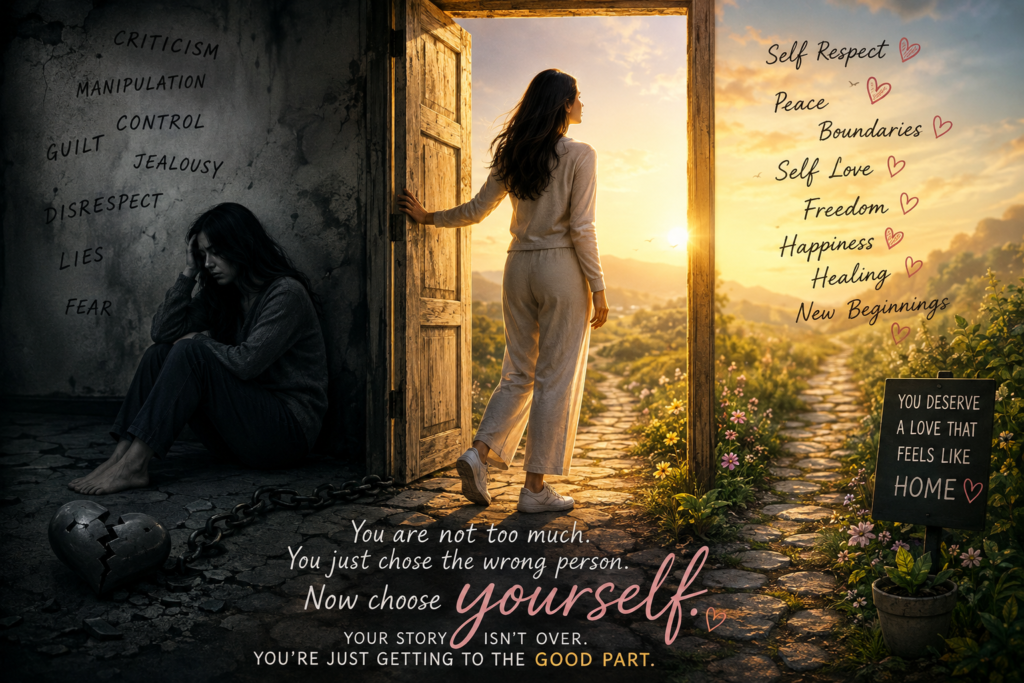
Choosing Yourself Doesn’t Make You Selfish
There comes a point when you have to stop asking, “How can I make this person love me better?”
And start asking:
“What is this relationship doing to me?”
Are you becoming happier, calmer, and more confident?
Or are you becoming anxious, insecure, exhausted, and afraid to be yourself?
Leaving a toxic relationship isn’t always easy, and it isn’t always something that can happen overnight. If there is violence, threats, intimidation, financial control, or any concern for your safety, don’t put yourself at greater risk by confronting the person impulsively.
Your safety comes first.
Talk to someone you trust. Build a support system. Keep important documents and financial information secure where possible, and seek appropriate professional or local support.
You don’t have to have your entire future figured out before taking the first step.
Sometimes the first step is simply admitting to yourself:
“This is hurting me, and I don’t want to live like this anymore.”
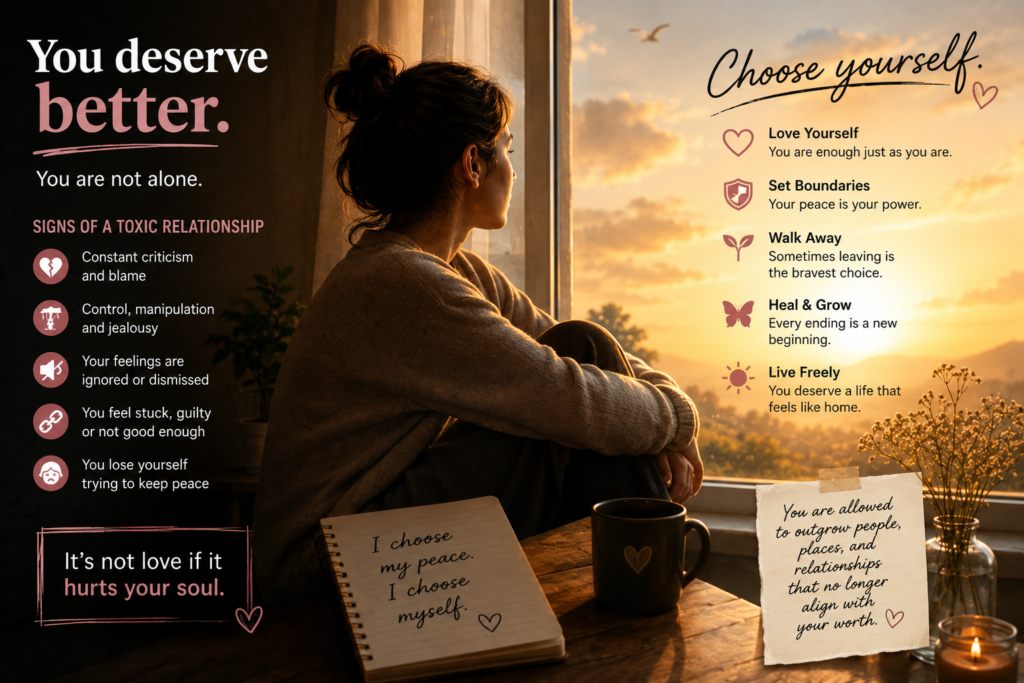
A Reminder for Every Woman
You are not difficult because you want respect.
You are not selfish because you want peace.
You are not asking for too much because you want honesty, affection, and emotional safety.
And you are not weak because it took you time to understand what was happening.
Sometimes we stay because we love someone.
Sometimes we stay because we hope they will change.
Sometimes we stay because we are scared of what comes next.
None of that makes you weak. It makes you human.
But there is a difference between loving someone and losing yourself for them.
Your worth has never been measured by how much pain you can tolerate.
You deserve a relationship where you can breathe, speak honestly, set boundaries, and still feel loved.
And sometimes choosing yourself doesn’t mean that your love story has ended.
It means you have finally decided that you belong in your own story too.